Bird Feeding Stations: A Window into Avian Behaviour
By Myrna Pearman, Mother Nature’s Naturalist and Backyard Birding Expert
Bird feeders offer us the opportunity to appreciate feeder birds while also facilitating the observation of diverse avian behaviors. These behaviors generally fall into two categories. Maintenance behaviors refer to actions performed by individual birds to care for their own bodies. Beyond fundamental needs such as eating and drinking (birds will consume water if accessible or obtain moisture by ingesting snow), maintenance behaviors include bathing (in dust, snow, water, rain, or sunlight), scratching, plumage ruffling and shaking, tail-fanning, bill-wiping, sleeping and preening.
The provision of consistent food sources within a defined space at feeding stations often creates competition among individual birds and between species that are all vying for food. Thus, they provide an excellent opportunity for observing social behavior. Competition leads to the establishment of a pecking order, with dominant birds acquiring the right to eat their fill before subordinate individuals. Dominance is usually determined by factors such as size (larger species tend to displace smaller ones) and age (older birds may chase away younger ones of the same species). In some species, particularly Downy Woodpeckers, males will chase away females, especially during winter.
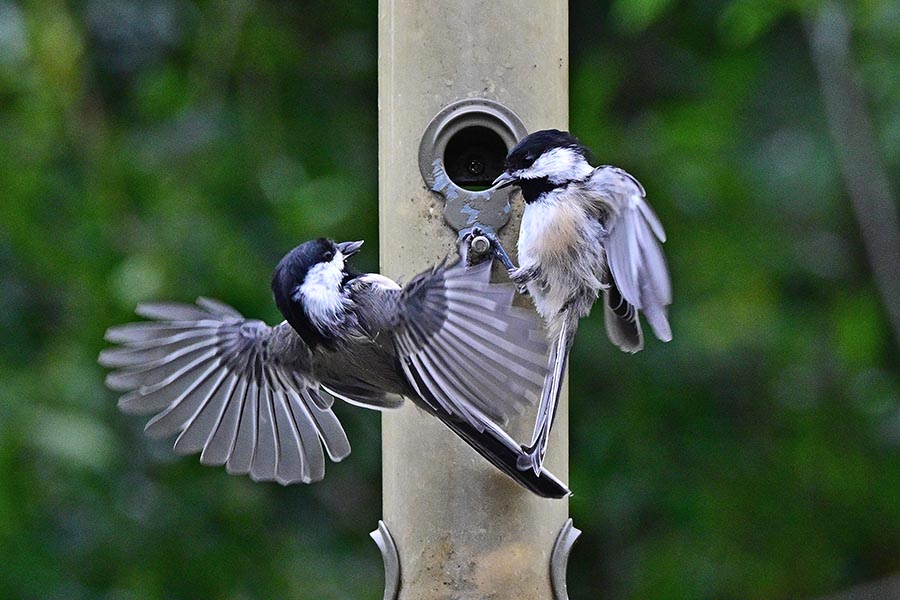
Four prominent behaviours associated with dominance hierarchy at feeders include
Displacement: A dominant or larger bird flies at a subordinate or smaller bird and displaces it.
Crest Raise: The feathers on the top of the bird's head are temporarily raised. This is often done by a bird that has just arrived at a feeder and is trying to find a dining spot.
Head Forward: The bird stretches forward, pointing its beak (which is often open) at the bird it is challenging.
Wing Droop: The bird raises its tail slightly while drooping the wingtips. This is a signal of aggression or dominance and is often used in conjunction with the head-forward stance.
Other interesting feeder bird behaviours to watch for:
- Some birds exhibit alarm behaviour if a predator approaches. Cats or other ground predators are usually subjected to a harsh scolding as the birds watch them from the safety of a nearby tree.
- If an aerial predator is spotted, a sentinel bird usually issues a whistle, whereupon all others within hearing distance will freeze in place until the threat subsides.
- Some flock species (notably redpolls) scatter at the slightest provocation. They return quickly to feed, only to repeat the entire process.
- Mobbing behaviour entails individuals of the same species cooperating to harass a potential predator. For example, blackbirds will mob ravens while chickadees, crows and jays will mob owls.
Have more questions? Visit your local Buckerfield's and we'll be happy to help!